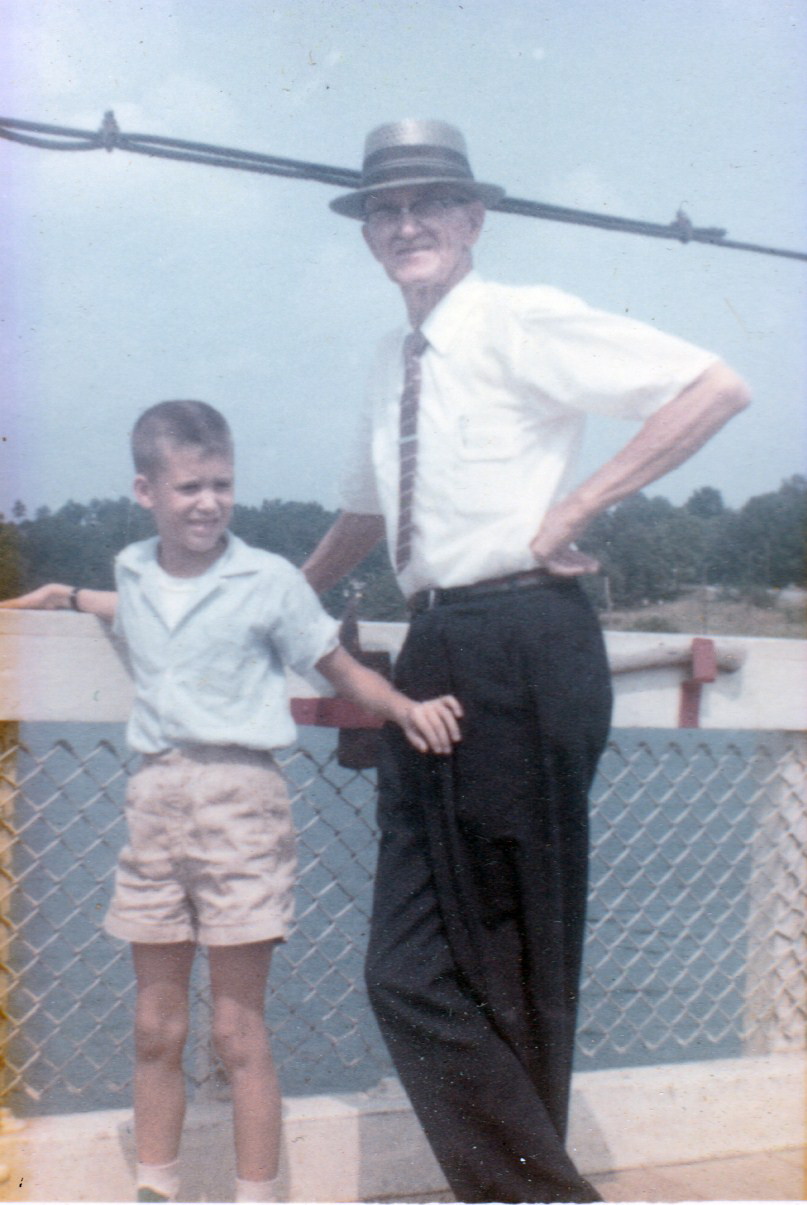
Born in the nineteenth century (September 7, 1886), my father was in his sixty-sixth year when I was born. (Yes, you read that correctly; there’s no typo.) His parents were born prior to the beginning of the Civil War, and he grew up in an antebellum Mississippi mansion in a family of ten children (seven boys and three girls). By the time World War II ended, his half-dozen brothers had exclusively produced either daughters or sons without male offspring. Therefore, Dad feared that his family name was in danger of extinction unless he produced a male heir. His own first marriage had resulted in one daughter who had no children of her own. His second marriage, which was to my mother, was essentially a marriage of convenience, somewhat like an arranged marriage, rather than anything resembling a marriage fueled by romantic love. It came about because his favorite nephew Roger (who had no children) was married to my mother’s favorite cousin Frances. Roger and Frances concocted the idea that an older and well-to-do farmer, who was lonely and needed a housekeeper, couldn’t do better than to marry an attractive divorcee with two young boys she was struggling to raise on her own. Likewise a financially challenged divorcee could do much worse than marrying an older man who promised to bequeath her his wealth and, in the meantime, teach her boys (his stepsons and my half-brothers) to work hard.
For all parties this unconventional marriage seemed a “win-win” situation. Then, after a couple of years of marriage, my father decided it would be desirable to have his own son, someone who would carry on the family name; my mother, by then in her fortieth year, thought, “Why not?” And that’s how I came to be the product of two parents who were more than a quarter-century apart in age and to have a paternal half-sister who was old enough to be my grandmother. (The story of “Aunt” Mari Lou, who was my half-sister, will have to wait for another day and another blog.)
Needless to say, growing up in such a family had advantages and disadvantages. For one thing we lived in the woods in a converted dance hall, and I grew up climbing trees and searching for frogs and crawdads in the ditches (not an especially auspicious beginning for someone who went on to earn two graduate degrees from Harvard). My much older maternal half-brothers were gone from home by the time I entered second grade; one joined the Navy and the other the Air Force. Therefore, I was reared essentially as an only child and often felt quite lonely living out in the country, two miles from town. However, Mother was also one of ten children (seven girls and three boys), so I grew up in relatively close vicinity to several aunts, almost all of whom were widows and many of whom (e.g., Aunt Lee, Aunt Beth, Aunt Rosamond, Aunt Irene, and Aunt Virginia) had no children of their own. I had paternal first cousins whom I never met because they were the children of Dad’s older siblings, born in the 1870s. But this blog is not about aunts, uncles, half-siblings, and cousins; it is about (not) having a father and the reflections that leads me to on Father’s Day.
While everyone technically has a father, my own was killed in a car accident when I was only eight years old. That means that during the remaining ten years I was home (age eight to eighteen) I was bereft of having a father to whom I could turn when I was bullied at school or when I was trying to figure out what puberty was all about or when I developed a crush. I was reared primarily by my mother in conjunction with an assortment of widowed and childless aunts. So what does Father’s Day mean to such a child? Here are three things it means to me:
- On Father’s Day I cherish the memories of the small things Dad did for me. Examples include the following: The one time he took me fishing, and I caught one small fish that Mother fed to the cat. The one time he taught me to shoot a rifle, and he kept the handmade bull’s eye target and showed it off to his fellow checker players. The one time he took me hunting, and my half-brother shot a few quail. The one time he made me ride a horse alone through the woods, even though I was terrified I would get lost, but I followed his directions and made it back safely. The one time he took me to a swimming lesson, and I learned to love swimming and it was the only physical education course in college that I got a straight A in. And the one time we went on a family vacation to the Ozark Mountain, and a photo taken on that trip is the last one taken of him alive. For the record, I do not cherish the one time he forced me to eat rattlesnake meat after he killed and skinned one and had Mother deep fry it. I was mortally afraid of all snakes; after eating the bite Dad made me take, I asked Mother, “When will I die?” (I was more afraid of his temper than I was afraid of dying.)
- On Father’s Day I reflect on and question how my life would have turned out had he lived. Would I have become a pugilist? (He bought me boxing gloves for my sixth birthday, and we watched boxing matches “Live from Madison Square Garden” every Saturday night.) Would I have become an expert marksman? (My half-brother, under Dad’s tutelage, became a superb shooter and hunter.) Would I have followed in his footsteps and become a farmer? (Well, I have acquired a few farms over the intervening decades, so maybe I did follow in his footsteps in that sense.) Would I have remained a Methodist? (When I was born, my father told my Baptist mother that he would rather see me dead than a Baptist. He was religiously intolerant.) Would I have become as intolerant, bigoted, and ill-tempered as he could be? (He once confiscated and burned the crucifix [read: “graven image”] of a Catholic relative.) The answer to most of these question is “I don’t know.”
- On Father’s Day I am grateful for the handful of men who took the time to think of me when it was time to do “boy things” or to have key growth experiences: For “Red” Shannon who would pick me up when I was in the fifth and sixth grades and drive me to nighttime sporting events that didn’t interest my mother. For the junior high basketball coach who chose me as one of two seventh-graders to be on the junior high team (until I broke my arm during a practice). For a minister who encouraged me as a teenager to be active in Methodist Youth Fellowship and who allowed me to play the organ during Sunday services. For the husband of my mother’s best friend who counseled me to move from my small hometown in rural Arkansas to the big city of Memphis, where I would be exposed to greater academic challenges and more social and cultural opportunities. For a religion professor in college who suggested that I pray sincerely about serving a mission despite my mother’s reluctance to let me go.
My take-away from these reflections is that, to quote a favorite scripture, “out of small things proceedeth that which is great.” We all need to take more time to do “small things” that are good for our children and grandchildren and for the children and grandchildren of our siblings and friends. What is small to us may be large to those sons and daughters. Likewise we need to be aware of those who do not have father figures in the home and ask ourselves how we can help to fill that absence in a way that is affirming and helpful to the remaining single parent and to the child.
In closing, I wish everyone a reflective Father’s Day. No earthly father is perfect, and I include not only my father but also myself in that statement. That does not mean that we cannot engage in a multitude of small things and create positive and memorable experiences for our children and surrogate children. That is what I have attempted to do since I myself became a father almost forty years ago, and that is what I hope to continue doing until I pass a miglior vita.
 The Many Worlds of Madison Sowell
Leave a comment